



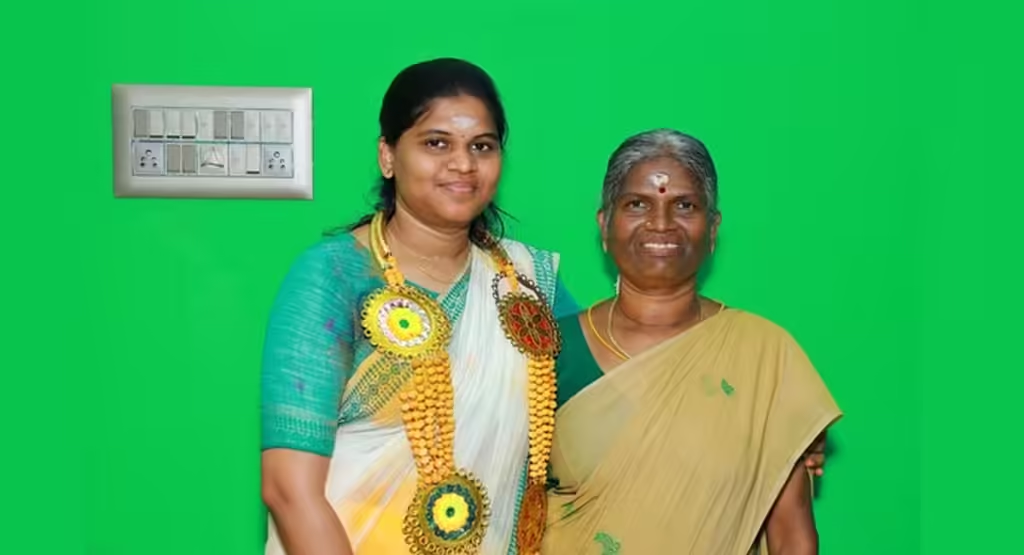
In a country where the UPSC Civil Services Examination is often described as one of the toughest competitive exams in the world, stories of resilience and determination continue to inspire millions. One such remarkable story is that of S. Inba, whose journey from studying with borrowed books to securing All India Rank 851 has captured the attention of aspirants across India.
Her success is not just about clearing an exam — it is a story of courage, discipline, and the power of dreams that refuse to fade despite financial and social challenges.
A Journey Built on Determination
For many UPSC aspirants, access to coaching institutes, premium study material, and guidance plays a major role in preparation. However, S. Inba’s journey stands apart because she prepared with limited resources, relying heavily on borrowed books, shared notes, and self-study.
Coming from a humble background, her story reflects the reality faced by thousands of aspirants from smaller towns and economically weaker families. While many students invest lakhs of rupees in coaching and study resources, Inba’s preparation was driven by resourcefulness and determination.
Borrowing books from friends, seniors, and libraries, she built her preparation strategy around consistency rather than luxury.
Her journey proves that success in UPSC is not decided by expensive coaching but by persistence and clarity of purpose.
The Union Public Service Commission examination continues to serve as one of India’s most merit-based pathways into administration, giving aspirants from diverse backgrounds an opportunity to transform their lives.
The Power of Self-Study
One of the most inspiring aspects of S. Inba’s journey is her dependence on self-study.
Instead of focusing on collecting too many books, she is believed to have concentrated on limited resources and multiple revisions — a strategy that many toppers and successful candidates recommend.
UPSC preparation is less about reading everything and more about understanding concepts deeply, connecting current affairs with static subjects, and developing strong answer-writing skills.
For aspirants, this story carries an important lesson:
It is not the number of books you own, but how many times you revise them.
Borrowed books, when used wisely, can be more valuable than an expensive library of untouched material.


Breaking Financial Barriers
Financial challenges often discourage talented students from pursuing dreams like UPSC. Coaching fees, accommodation in preparation hubs like Delhi, and study materials can become major obstacles.
S. Inba’s success breaks this myth.
Her story reinforces the growing reality that digital resources, public libraries, and shared study communities are changing the UPSC preparation landscape.
Today, aspirants from rural and semi-urban India are increasingly clearing the exam through disciplined self-study and online guidance. Recent trends also show how the social and geographical map of UPSC success is expanding beyond metro cities.
This is a powerful signal for students who believe lack of money is the end of the road.
It is not.
Sometimes, it is simply the beginning of a stronger story.
Rank 851: A Milestone, Not Just a Number
Securing AIR 851 in UPSC is a massive achievement.
Every year, lakhs of candidates appear for the examination, but only a limited number make it to the final list. Reaching this rank means surviving the intense pressure of Prelims, Mains, and Interview stages.
Each stage demands different skill sets:
- factual accuracy
- analytical writing
- time management
- mental resilience
- personality assessment
For someone preparing with borrowed books, this rank becomes even more meaningful.
It symbolizes not only academic capability but also the strength to rise above circumstances.
Inspiration for Millions of Aspirants
India is full of UPSC stories that inspire. Many rank holders come from modest backgrounds and fight social and economic odds to succeed.
S. Inba now joins that inspiring list.
Her journey sends a clear message to every student:
Your background does not define your future.
What matters is discipline, hard work, and belief in yourself.
Many aspirants lose motivation after one or two failed attempts, but stories like Inba’s remind us that persistence often separates success from failure.
The Changing Face of UPSC Preparation
The success of candidates like S. Inba also reflects a major shift in the UPSC ecosystem.
Earlier, aspirants often believed that relocating to Delhi or joining expensive coaching was essential.
Today, that belief is changing.
Online lectures, free study PDFs, topper strategies, YouTube discussions, and digital current affairs platforms have democratized access to knowledge.
Even many aspirants on public forums discuss how books are often shared, borrowed, or accessed digitally during their preparation journey.
This shift is creating equal opportunities for students from all sections of society.
More Than an Exam Success
UPSC success is never just about clearing an exam.
It represents entry into India’s administrative framework — a chance to influence governance, public service, and nation-building.
From borrowed books to bureaucracy, S. Inba’s journey is symbolic of what the civil services truly stand for:
merit, service, and transformation.
Her story is not just news.
It is motivation.
It is hope.
It is proof that dreams backed by effort can rewrite destiny.
Final Thoughts
S. Inba’s achievement is a reminder that extraordinary success can emerge from ordinary circumstances.
A borrowed book can become the first step toward a government office.
A shared notebook can become a bridge to public service.
And a dream, when pursued relentlessly, can lead to the corridors of bureaucracy.
For every UPSC aspirant reading this, her story says one thing loud and clear:
Keep going. Your rank may be one attempt away.
Article Ref: The logical Indian